Sunday, June 10, 2007

Cedar Plank Tilapia


We bought some cedar planks at the Carrboro Farmer's Market with the intent to grill some type of fish. I was somewhat familiar with the concept of grilling trout but since tilapia was on super special at the Teeter, the choice was made for us. I'll have to admit I was more than a bit skeptical about the impact the cedar would have on the taste. I've grilled with hickory chips before and always love the taste charcoal grilling gives -but always felt that these were more nuances than the main show.

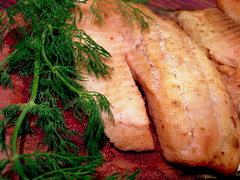
We marinated the tilapia fillets in Scott's Barbeque sauce (Scott's is good for more than just pork and chicken) for a couple hours prior to grilling. I thought that with a sauce that powerful, we'd barely be able to tell the difference between plank grilling or normal grilling. Boy, was I wrong. The tilapia just soaked up the cedar smokiness and served as a wonderful compliment to the marinade.

The following are the instructions --

Soak the cedar plank well - ideally at least a few hours, but the longer the better. Set up the grill for direct grilling on medium-high. When ready to cook, place the plank on the hot grate and leave it until there is a smell of smoke, about 3 to 4 minutes. Turn the plank over and place the fish on top. Cover the grill and cook until the fish is cooked through, reaching an internal temperature of 135 degrees. Check the plank occasionally - if the edges start to catch fire, mist with water, or move the plank to a cooler part of the grill. Cooking time will probably be about 20-25 minutes.

Saturday, June 09, 2007

Grilled stuffed chicken breasts


It's not really a big secret - but we eat a lot of chicken. To prevent chicken fatigue, sometimes it's necessary to kick things up a notch and take the old-school grilled chicken breast to a new level. With some sage advice from my grilling mentor Steven Raichlen - we tweaked his basic recipe just a bit with some really tasty results.

Ingredients
3 -4 large chicken breasts
7-8 large basil leaves or equivalent
5-6 pieces of sun dried tomatoes
1 chunk of asiago cheese

Marinade
1 cup olive oil
juice from 1 lemon
2-3 crushed garlic cloves
salt
pepper

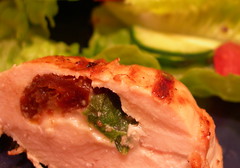
Trim the "tenderloins" and any fat off the chicken breasts and cut each breast in half. Place each half flat on a cutting board and, using the palm of one hand to hold the breast flat, cut a deep horizontal pocket in the side with a slender knife. Make the pocket as large as you can without piercing the top or bottom of the breast. As for the stuffing, we chose to use asiago cheese, fresh lemon basil leaves, and sun-dried tomatoes - but pretty much anything within reason would work. Insert the stuffing into the pocket and seal the breast with toothpicks. Lay the breasts in a flat pan and cover with the marinade, flipping a couple times to coat both sides. We marinated for 20-30 minutes, but the real flavor comes from the stuffing. Grilling time is basically the same as for normal chicken breasts - probably 10 minutes or so on medium high.

This is a really easy, quick way to spice up the usual chicken breast routine and also provides a way to show off some fancy grill marks on the outside and an impressive cross section of flavors on the inside. This is something we'll definitely be doing again.

Monday, May 28, 2007

Burger time - Blackwood Picnics


Much like there is no excuse for our recent lapse in posts, there is no excuse for eating a dry, tasteless, boring burger when there are some very easy and tasty alternatives. I picked up some ground bison at the Carrboro Farmer's Market as a different twist - usually, we steer towards turkey burgers but on occasion I'll partake of some old fashioned red meat. The trick with an extra lean type of meat like bison (or extra lean turkey/beef ) - is how to preserve that juiciness a true burger connoisseur expects. We start with this mixture - the egg provides that extra moisture and helps to bind things together for better patty formation:

1 pound ground bison
1/2 cup bread crumbs
1 egg
salt
pepper

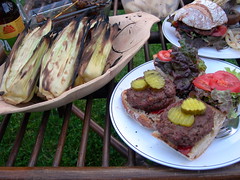
The secret ingredient, however, is a pat of flavored butter. Once the meat mixture is done and the patties have been formed, you separate each patty into two halves, insert the butter in the middle and seal things back up again. The same trick can also be used with blue cheese (especially good with turkey) - but this time out, rosemary butter was the condiment of choice. Once the burgers were grilled to satisfaction, the spread was completed with a ciabatta bread roll, fresh lettuce and tomatoes from the farmer's market, pickles, ketchup, and a little bit of mayo and mustard. I know we're in North Carolina, but chili and slaw has no place on this burger.

And although it's not in season yet - we picked up some corn from the HT to throw on the grill as well. Similarly, butter application is the key to good grilled corn. Remove the corn silk and jam some flavored butter inside the husk, as well as salt and pepper. Throw the corn on the grill - husk and all, and let the grill do the work. Indirect heat is probably the better option - but lower heat will work as well.

Burgers, grilled corn, and cold beer in the backyard cannot be beat on a warm weekend afternoon. Pick yourself up some bison and get to work!

Wednesday, March 14, 2007

Pad Thai


We've had a few weeks of illness around here, and while we have been feeding ourselves reasonably well (all things considered), blogging about those nourishing meals tended to fall by the wayside. It seems we're finally back on our feet, so maybe Blackwood Eats will get back on track as well.

Jeff recently took a trip to the Silver Wok Asian Gourmet in Mariakakis Plaza and brought home some rice stick noodles and tamarind pulp. I decided to try my hand at pad thai -- it's a dish I love the idea of (spicy... peanut-ty...yum!), but often find too sweet at restaurants, so I had high hopes for the diy approach. Plus, it gave me a chance to turn to one of my most beautiful cookbooks that, sadly, I rarely use: Hot Sour Salty Sweet: a culinary journey through southeast asia, by Jeffrey Alford and Naomi Duguid (worth buying for the photography alone).

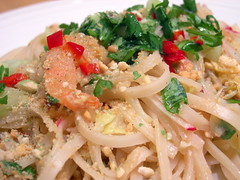
I adapted the recipe slightly: I left out the pork (which I don't eat), used fresh shrimp instead of dried (which I didn't have) and threw in some shredded savoy cabbage with the scallions (because I needed to use it up). Other than that, I followed the recipe pretty much exactly, and the result was everything I hoped for: savory, spicy-hot, with a vinegar bite tempered by a hint of sweetness. Make sure to serve with all the accompaniments -- they add so much to the taste AND look great on the table!

Pad Thai
1/2 lb narrow dried rice noodles
1 1/2 T tamarind pulp
1 1/2 T soy sauce
1 1/2 T Thai fish sauce
3 large eggs
3 T peanut oil
3 cloves garlic, minced
4 oz pressed tofu, cut into narrow strips an inch long
1/4 lb shrimp, peeled and chopped a little
1/2 lb mung bean sprouts
3 scallions, chopped
1 cup shredded cabbage (optional)

Note: there's a lot of prep here, but once that's done the cooking is quick.
1) Soak the rice noodles in warm water for 20 minutes, then drain
2) Dissolve the tamarind pulp (which is thick, stringy, and mixed with big seeds) in 3 to 4 T warm water, then press through a sieve. (If you don't have it, substitute 1 T lemon juice plus 1 T water.) Mix the resulting liquid with the soy sauce and fish sauce in a small bowl.
3) Beat the eggs with a pinch of salt in another bowl.
4) Heat a large pan (or wok, if you have it) over moderately high heat and add half the oil. Stir-fry the garlic, then add the tofu and shrimp and cook just until the shrimp are pink.
5) Add the eggs and cook until they set around the shrimp and tofu (fritatta-style). Cut into big pieces, remove from pan, and set aside.
6) Add remaining oil to the pan, then stir-fry the noodles, pressing them against the pan, turning them, and pressing them again. They start out pretty hard, but soften up in about a minute. Unless you have a really big pan, you might need to do this in two batches. Remove the noodles to your serving dish.
7) In the same pan, stir-fry the scallions, bean sprouts, and cabbage just until wilted. Add the soy sauce mixture, then the reserved fritatta pieces (break them up some now). Pour over the noodles and toss to mix everything together.

Accompaniments
1/2 cucumber, seeded and thinly sliced
1 lime, cut into wedges
1/2 cup roasted peanuts, coarsely chopped
4 T chopped cilantro
Chile-Vinegar Sauce: dissolve 3 T sugar in 1/2 cup rice vinegar; add 1 small hot pepper, sliced thin

Plate up the noodles and pass the accompaniments in small bowls for each person to add to his or her taste for a delicious one-dish meal.
Friday, February 16, 2007

Grilled Tuna with Golden Beet Salad


While the food itself wasn't super fancy, we grilled up some fine looking rare tuna with a pretty simple marinade as an excuse to use some grains of paradise. The specs on the tuna itself are grains of paradise, a West African spice that is sometimes used as a substitute for black pepper. I think we found the difference to be subtle - but an excellent combination with a very basic lemon and olive oil marinade.

According to Wikipedia -- "Grains of paradise are commonly employed in the cooking styles of West Africa and North Africa, where they have been traditionally imported via caravan routes through the Sahara desert. Grains of paradise became a very fashionable substitute for black pepper in the 14th and 15th century Europe, especially in northern France, one of the most populous regions in Europe at the time. In the early modern period, the craze for the spice waned and it became more common as a flavorer for sausages and beer. Today it is largely unknown outside of West and North Africa except fas flavorers in some beers and gins.

In West African folk medicine, Grains of Paradise are valued for their warming and digestive properties. Grains of Paradise have been introduced to the Caribbean Islands, where they are used as medicine and for religious (voodoo) rites."